Services » Exploration of underground fresh and thermal-mineral waters

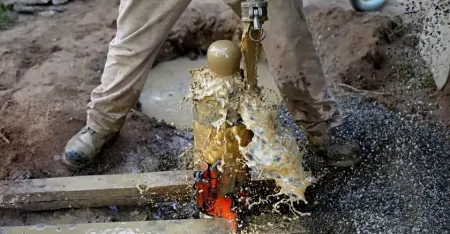
Geological and hydrogeological research is conducted through drilling and water quality analysis, with the aim of locating underground fresh water resources.

The main methods for the exploration and preliminary investigation of fresh, reservoir, and underground water sources include vertical electrical sounding (VES, VES-VP) and broken wave seismic exploration (REW). When studying deep artesian basins, reflection wave methods and electrical exploration (DZ, ZSB, MTZ) are used. Broken water-saturated zones are identified using electromagnetic profiling methods. The details of zones identified with fissure-karst waters are determined using circular profiling (KEP) and circular vertical sounding (CVS) methods.

3iu4hrjk_173188413766798_173188679253153.webp


The main objectives of geophysical methods in the exploration and detailed investigation of underground water sources are:

  • During the exploration phase: identifying water-bearing porous or fractured and karst rocks, studying groundwater, layers, and fractures, and creating lithological maps with plans and depths while assessing geophysical and hydrochemical conditions.
  • During the preliminary investigation phase: studying the lithological structure, identifying zones of increasing water yield based on filtration coefficients and hydraulic conductivity values, determining the depths and thicknesses of aquifers and aquitards, and identifying "hydrogeological windows" that connect local aquifers between different water-bearing layers, along with hydrogeochemical mapping of zones with various mineralization of groundwater.
  • During the detailed investigation phase: specifying and validating preliminary exploration data through well drilling, and determining the operational reserves of groundwater with various mineralizations by analyzing all bed materials and well data, including regular geophysical observations.

Partners